
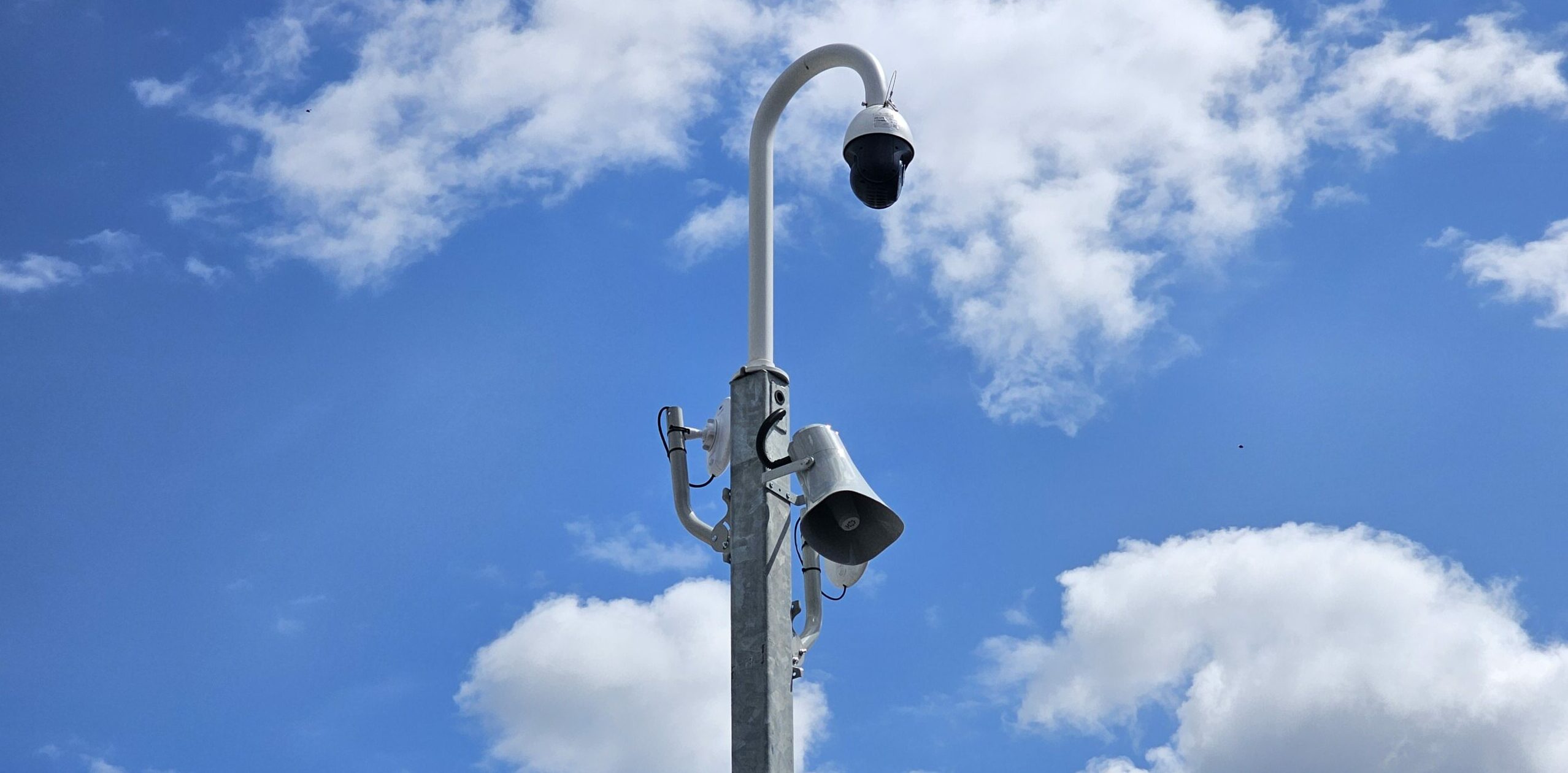
Commercial CCTV installation Northamptonshire businesses need has changed significantly over the last decade. Modern IP cameras deliver 4K footage, allow remote access from your phone, and integrate with alarm and access control systems. But with more options comes more complexity — and choosing the wrong system means wasted spend, blind spots, or footage you can’t actually use when you need it.
This guide covers everything a Northamptonshire business owner needs to know before committing to a commercial CCTV installation — from technology choices and camera types through to storage, night vision, and what questions to ask any installer.
— Key takeaways
- Go IP, not analogue. Better image quality, smarter alerts, easier to expand.
- Mix resolutions: 8MP at entry points for face ID, 4MP for general coverage.
- Colour night vision on all external cameras — IR-only is no longer good enough.
- Budget £800–£2,500 for a typical small business install with 4–6 cameras.
- 30 days of footage retention is standard and meets most insurer requirements.
— In this guide
01IP CCTV vs Analogue
02How many cameras do you need?
03Choosing the right camera type
04Resolution: what do you actually need?
05Storage: NVR vs Cloud
06Night vision and low-light performance
07Do you need planning permission?
08Brands worth considering
09Questions to ask any installer
10Frequently asked questions
IP CCTV vs Analogue: Which Is Right for Your Business?
The most important decision you’ll make for any commercial CCTV installation is the technology type. Almost all new installations across Northamptonshire now use IP (Internet Protocol) cameras rather than traditional analogue systems — and for good reason.
| IP CCTV | Analogue / HD-over-coax | |
|---|---|---|
| Resolution | 2MP up to 12MP (4K) | Up to ~5MP |
| Recorder | NVR (Network Video Recorder) | DVR (Digital Video Recorder) |
| Cabling | Cat5e/Cat6 Ethernet (PoE) | Coax (existing installs only) |
| Smart features | Motion zones, line crossing, AI alerts | Limited |
| Scalability | Add cameras without rewiring | Limited by DVR channel count |
| Remote access | Yes — full app access | Basic, varies by DVR |
| Best for | New installations, all sizes | Upgrading existing coax installs |
Our recommendation: For most new commercial CCTV installations, IP with an NVR is the right choice. The higher upfront cost is offset by better image quality, smarter alerts, and lower long-term maintenance.
How Many Cameras Does Your Business Need?
There’s no one-size-fits-all answer, but a useful starting point is to map the areas you need to cover. When we carry out a free site survey for Northamptonshire businesses, these are the zones we always assess first:
- Entry and exit points — every external door and gate. A minimum of one camera per access point, ideally two (wide-angle overview + close-up for face identification).
- Car parks and yard areas — wide-angle bullet cameras or PTZ (pan-tilt-zoom) cameras for large open areas.
- Reception and front of house — dome cameras for discreet coverage.
- Warehouse, stock room, or server room — particularly important for insurance compliance and loss prevention.
- Perimeter fencing — consider thermal or wide-angle cameras with motion detection alerts.
Small business
£800–£2,500
4–8 cameras
Office or retail unit
Medium site
£2,500–£4,500
8–16 cameras
Warehouse / industrial
Large / multi-site
£4,500+
16+ cameras
Multi-building operation
Choosing the Right Camera Type
Dome cameras
The most common type for indoor commercial CCTV installations. Low-profile, vandal-resistant, and the wide dome housing makes it difficult for people to tell exactly where the camera is pointing. Best for: offices, reception areas, corridors.
Bullet cameras
Long cylindrical housing, typically used outdoors. Visible deterrent effect, better suited for covering long distances like car parks and driveways. Best for: external walls, gated entrances, car parks.
PTZ cameras (Pan-Tilt-Zoom)
Motorised cameras that can be remotely controlled to pan, tilt, and zoom. Useful for large open areas where you need to track movement, but they are more expensive and require ongoing management. Best for: large yards, industrial sites, town centre premises.
Fixed vs varifocal lenses
Fixed lens cameras are cost-effective for defined areas. Varifocal lenses let your installer adjust the field of view during setup — useful for awkward spaces or when you’re not sure of the exact viewing angle required. We recommend varifocal for most external camera positions on commercial installations.
Resolution: What Do You Actually Need?
Resolution is one of the most misunderstood specs in CCTV. Higher isn’t always better — it depends on what you’re trying to capture and at what distance.
| Resolution | Use case | Storage (per camera, 24hr) |
|---|---|---|
| 2MP (1080p) | Short-range indoor coverage, general overview | ~7–10 GB/day |
| 4MP (1440p) | Good all-rounder for indoor and outdoor | ~14–18 GB/day |
| 8MP (4K) | Entry points requiring face identification, high-value areas | ~25–35 GB/day |
| 12MP | Wide-area coverage where you need to digitally zoom in post-event | ~40–50 GB/day |
Practical approach: Use 8MP cameras at entry and exit points where face identification matters, and 4MP cameras for general area coverage. This balances image quality with storage costs and is the setup we recommend most often for Northamptonshire SMEs.
Storage: NVR vs Cloud
You have two main options for storing footage:
On-site NVR (Network Video Recorder)
A dedicated device, usually installed in a locked cabinet, that stores all footage locally on hard drives. Most businesses retain 30 days of footage as standard — your insurer may specify a minimum. NVRs can be configured to overwrite old footage automatically. No ongoing subscription costs, but the device needs to be secured against theft or damage.
Cloud storage
Footage is uploaded to secure off-site servers. Useful for high-risk premises where on-site equipment could be targeted. Ongoing monthly costs apply (typically £5–£20 per camera per month depending on retention period). Some businesses use a hybrid approach — local NVR with cloud backup for critical cameras.
Night Vision and Low-Light Performance
CCTV that produces blurry, grainy footage after dark is effectively useless — and it’s one of the most common complaints we hear from businesses across Northamptonshire who’ve inherited a poorly specified system. Look for:
- IR (Infrared) night vision — standard on most cameras. Produces black-and-white footage in complete darkness. Range varies from 20m to 80m+.
- Colour night vision — uses a larger image sensor to produce colour footage in low light (not complete darkness). Significantly more useful for identification purposes.
- Starlight / low-light sensors — premium cameras with large sensors (e.g. Hikvision AcuSense, Dahua WizSense) that perform well in near-darkness with ambient light present.
Our recommendation: For most external business cameras, colour night vision or starlight-rated cameras rather than standard IR-only models. The difference in footage quality at 11pm is significant.
Do You Need Planning Permission for Business CCTV?
In most cases, no planning permission is required for commercial CCTV installation on business premises in England. However, there are exceptions:
- Listed buildings may require listed building consent.
- Conservation areas may have restrictions on external fixtures — worth checking if your premises are in a Northamptonshire conservation zone.
- Cameras pointing into public areas (streets, pavements) must comply with GDPR and may require registration with the ICO as a data controller.
You are legally required to display signage notifying people that CCTV is in operation. Your installer should supply and fit these as part of the installation.
Brands We Install Across Northamptonshire
The commercial CCTV market is dominated by a handful of manufacturers. For our Northamptonshire installations, we use and recommend:
- Hikvision — market leader, excellent reliability, strong software ecosystem, wide product range from budget to 4K. The AcuSense range offers AI-powered object detection to reduce false alerts.
- Dahua — comparable to Hikvision in quality and price, strong low-light performance, good value for money. The WizSense range includes built-in AI analytics.
- Uniview — slightly premium positioning, excellent image quality, good for high-end installations.
Worth noting: Avoid unknown-brand cameras sold online. Compatibility, firmware support, and long-term parts availability are major issues when systems need maintenance or expanding.
How to Choose a Commercial CCTV Installation Company in Northamptonshire
Whether you’re getting quotes from us or comparing commercial CCTV installation companies across Northamptonshire, these are the questions every business owner should ask before signing anything:
- Will you provide a free site survey and written quote?
- Do your engineers install directly, or do you subcontract?
- What brands and models do you install, and why?
- How much storage is included, and for how many days of footage retention?
- Will I be able to access footage remotely on my phone?
- What warranty is included on hardware and workmanship?
- Do you offer ongoing maintenance contracts?
- Can the system integrate with my existing alarm or access control?
Frequently Asked Questions
How much does commercial CCTV installation cost in Northamptonshire?
A typical small business installation with 4–6 IP cameras, an NVR, and cabling runs between £800 and £2,500 fully installed. Larger systems with 8–16 cameras on an industrial or multi-building site typically cost £2,500–£6,000+. Prices vary based on camera count, resolution, cabling runs, and whether external groundworks are required. We always provide a written, itemised quote after a free site survey.
How long does CCTV installation take?
A standard 4–8 camera installation typically takes one full day. Larger systems with extensive cabling or multiple buildings may take 2–3 days. We work to minimise disruption to your business and can schedule work outside trading hours where needed.
How long should CCTV footage be retained?
Most businesses retain footage for 30 days, which is the standard recommended by the ICO and sufficient for most insurance and incident investigation purposes. Some insurers specify a minimum (often 28 days). High-risk premises or those handling sensitive data sometimes retain footage for 60–90 days.
Can I access my CCTV remotely on my phone?
Yes — all IP CCTV systems we install include remote access via a smartphone app (iOS and Android). You can view live footage from any camera, review recorded clips, and receive motion alert notifications. We set this up and walk you through it as part of every installation.
Do I need a maintenance contract for CCTV?
Not strictly required, but recommended. A maintenance contract typically covers annual health checks, firmware updates, hard drive monitoring, and priority response if a camera or NVR fails. For businesses where CCTV is critical to insurance compliance, a maintenance contract provides peace of mind that the system is always operational.
Can CCTV be integrated with an alarm system?
Yes. Modern IP CCTV systems can integrate with intruder alarms so that a triggered alarm automatically brings up the relevant camera feed, or triggers recording at a higher frame rate. We install both CCTV and alarm systems across Northamptonshire and can design an integrated solution from the outset.
— Considering CCTV?
Free site survey. No obligation.
We specialise in commercial CCTV installation across Northamptonshire — Northampton, Kettering, Daventry, Wellingborough and surrounding areas. Local engineers, no subcontractors, no pressure.
Or call us: 01604 422760
